Molecular and Optical Physics Laboratory (MOPL)
The Molecular and Optical Physics Laboratory (MOPL) is an integral part of Macquarie University's MQ Photonics Research Centre (incorporating the former Centre for Lasers and Applications, established in 1988 as an Australian Commonwealth Special Research Centre).
The MOPL facility is located in the basement of building WW4 (formerly F7B). It was previously known as the Chemistry Laser Applications Laboratory until 2003, when the research group leader, Brian Orr, retired as Professor of Chemistry, was appointed Emeritus Professor in the area of Molecular and Optical Physics, and moved to the Department of Physics and Astronomy.
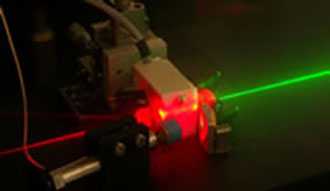
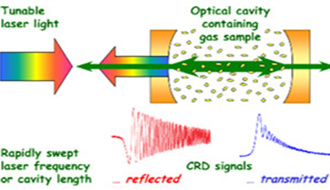
MOPL's research interests cover a range of topics in molecular and optical physics, applying laser and spectroscopic techniques – notably molecular energy-transfer processes, high-resolution spectroscopy, photochemistry, chemical analysis, nonlinear optics, cavity-enhanced optical techniques, photonic techniques, and laser-based instrumentation. Recent work has focused on narrowband tunable optical parametric oscillators, novel forms of cavity-ringdown spectroscopy, high-fidelity frequency transfer over optical fibres, nonlinear-optical spectroscopic techniques, and optical sensing applications to agriculture, livestock, biomedicine, wastewater treatment and the atmospheric environment.
The MOPL group has aimed to develop, patent, and commercialise laser-based instruments for spectroscopic sensing in industry, medicine, agriculture, and the environment.
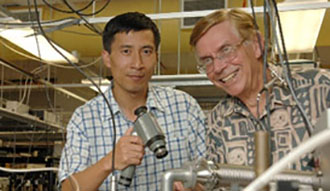
MOPL members, Professor Brian Orr and Dr Yabai He have developed several items of laser-based intellectual property, covered by four patent applications. They have also collaborated extensively with researchers in other universities (both in Australia and abroad), in industry and in government institutions.
Recent publications from the MOPL research group appear in journals such as Optica, Optics Letters, Optics Express, Journal of the Optical Society of America B, Applied Optics, Applied Physics B, JQSRT, Molecular Physics, and Chemical Physics Letters.